
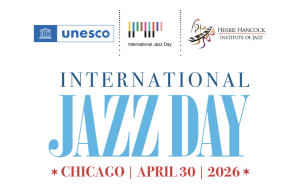
Chicago will take center stage this spring as the Global Host City for International Jazz Day 2026, marking the 15th anniversary of the worldwide celebration with an unprecedented month-long series of concerts, education programs, and community events across the city from April 1 through May 2, 2026.
International Jazz Day was initiated in 2011 by Chicago native jazz legend Herbie Hancock. Jazz Day is celebrated annually in more than 190 countries and recognized on the official calendars of the United Nations and UNESCO. The 2026 Chicago edition represents significant milestones, including the most expansive program in the event’s 15-year history and the return of the global celebration to the United States after a decade. The celebration culminates in an All-Star Global Concert on April 30, broadcast live worldwide from the Lyric Opera of Chicago.
“I'm excited that Chicago, my hometown, is hosting International Jazz Day 2026. It was in my Chicago high school auditorium that I discovered jazz, an event that sparked a lifelong passion and commitment to this powerful art form,” said Herbie Hancock. “Jazz opened doors to creativity, self-expression and freedom. I hope that this Day will inspire young artists and audiences in the same way that I was inspired during those formative years.”
International Jazz Day has the strong support of the State of Illinois, the City of Chicago, and a broad coalition of civic, cultural, and business leaders.
“Today is an incredible celebration of an art form that helped shape America’s cultural heartbeat and found one of its greatest homes here in Chicago,” said Governor JB Pritzker. “Throughout our history, Illinois has been a hub of jazz music where many of the greats performed, made their names, and transformed the genre. Jazz is part of the history and cultural lifeblood of Chicago, and I can’t think of a better place to celebrate the genre’s roots and enduring legacy during International Jazz Day.”
“Chicago's vibrant jazz legacy runs deep. Since the earliest days of the Great Migration, jazz has been interwoven with our city's cultural fabric and identity,” said Mayor Brandon Johnson. “Hosting International Jazz Day in 2026 here in Chicago is a tremendous honor and a powerful testament to the enduring spirit and innovation of our musicians and our passionate jazz community.”
This heritage will be on full display as neighborhoods, schools, cultural institutions, and performance venues across Chicago come together for the month-long celebration.
An Unmatched Artist Lineup at the Global Concert
At the heart of International Jazz Day 2026 is the 15th Anniversary All-Star Global Concert, the largest and most ambitious in Jazz Day history, with more than 40 artists from across the globe already confirmed. The genre-spanning lineup reflects jazz’s evolving influence, blending jazz, blues, classical, hip-hop, and global music traditions, with notable Chicago artists prominently represented.
Confirmed artists include Melissa Aldana, John Beasley (Musical Director), Terence Blanchard, Dee Dee Bridgewater, Till Brönner, Terri Lyne Carrington, James Carter, Jacob Collier, Béla Fleck, Renée Fleming, James Genus, Robert Glasper, Christian McBride, Marcus Miller, Gregory Porter, Dianne Reeves, Gonzalo Rubalcaba, Bobby Watson, and Lizz Wright, among many others, including Chicagoans Bobby Broom, Ernest Dawkins, Kurt Elling, Herbie Hancock, Marquis Hill, Joel Ross and Jahari Stampley. Additional artist announcements to come.
Chicago natives Herbie Hancock and Kurt Elling will serve as Co-Artistic Directors of the Global Concert. Elling, a multi Grammy-winning jazz singer and Chicago native currently starring in the Broadway production of “Hadestown,” joins Hancock in shaping a program expected to be viewed by hundreds of millions worldwide via YouTube, UN TV, UNESCO, jazzday.com, Facebook and other platforms.
Citywide Leadership and Community Impact
Local programming is spearheaded by the Chicago Jazz Alliance, a coalition of civic and cultural organizations initiated by Kurt Elling and led by EXPO CHICAGO founder Tony Karman, which brought together the Department of Cultural Affairs and Special Events (DCASE), the Jazz Institute of Chicago, Ravinia Festival, the Reva and David Logan Center for the Arts at The University of Chicago, and many others. This effort is undertaken in partnership with the Herbie Hancock Institute of Jazz, UNESCO’s designated partner for International Jazz Day with Quintin Primo III and Michael Reschke serving as Host City Co-Chairs.
Together, the partners will develop a month-long program of education and community outreach, including masterclasses, concerts, pop-up performances, youth programs, and collaborations with major Chicago cultural, educational, and civic organizations along with local colleges and universities, and prominent jazz clubs throughout the area. ensuring Jazz Day reaches audiences across Chicago’s neighborhoods.
An overview of scheduled events and partner organizations to date is provided in the appendix for reference.
For more than a century, Chicago has been a global jazz capital and a continuing source of innovation. In the 1910s and 20s, the Great Migration brought to Chicago such legends as Louis Armstrong, Jelly Roll Morton, and King Oliver, three of the prime architects of the earliest jazz; in the 1930s, Chicago native Benny Goodman established the orchestra that would soon launch the Swing Era nationwide. When bebop swept through the 1940s, Chicago musicians like Gene Ammons, Eddie Harris, and the Freeman brothers (Von and George) put their own stamp on it, while Lennie Tristano conceived and taught a minimalist alternative that paved the way for the impending “cool jazz” movement.
Chicago in the 50s is where the Afrofuturist visionary Sun Ra assembled his first Cosmic Arkestra, and where Muhal Richard Abrams began working with other luminaries (Roscoe Mitchell, Henry Threadgill) who would form the Association for the Advancement of Creative Musicians in the 60s. The AACM came to symbolize the second wave of the jazz avant-garde and re-established Chicago as a home for experimentation, seen today in the work of progressive artists Ken Vandermark, Tomeka Reid, Marquis Hill, Jeff Parker, and “beat scientist” Makaya McCraven, and in Kurt Elling’s quantum leap in vocal jazz. Now come such twenty-something mover/shakers Isaiah Collier and Jahari Stampley, appearing at iconic Chicago venues like the Jazz Showcase, the Green Mill, and the renowned Chicago Jazz Festival (est.1979), and already framing the discussion for the jazz to come.
A Global Moment Rooted in Chicago
International Jazz Day 2026 also marks the symbolic return of the celebration to the United States, following 2016 International Jazz Day at the White House, hosted by President Barack Obama and Chicago native and First Lady Michelle Obama. After passing through Abu Dhabi in 2025, the global spotlight now turns to Chicago.
Further reinforcing the city’s longstanding connection to International Jazz Day, United Airlines, headquartered in Chicago, has served as International Jazz Day’s Official Airline Partner since the program’s founding in 2011, supporting artists and cultural exchange around the world.
International Jazz Day 2026 will encompass thousands of events worldwide spanning small towns and major cities alike, from intimate performances to large-scale concerts at leading cultural institutions. Artists, educators, and organizations around the globe will present masterclasses, jam sessions, panel discussions, and educational workshops, underscoring jazz’s enduring role as a powerful force for unity, dialogue and cultural exchange.
To learn more about International Jazz Day 2026 and how to get involved in the celebrations in Chicago, visit chicago.jazzday.com or unesco.org/en/international-jazz-day
About the International Jazz Day
Established by the General Conference of UNESCO in 2011 and recognized by the United Nations General Assembly, International Jazz Day brings together countries and communities worldwide every April 30. The annual International Jazz Day celebration highlights the power of jazz and its role in promoting peace, dialogue among cultures, and respect for human dignity. International Jazz Day has become a global movement reaching more than a billion people annually on all continents through education programs, performances, community outreach, radio, television and streaming, along with electronic, print, and social media. The Herbie Hancock Institute of Jazz serves as the lead nonprofit organization charged with planning, promoting and producing International Jazz Day in the Host City and around the world each year.