

Dear Neighbor,
Starting Jan. 1, 2027, a number of Hoosier Medicaid recipients must meet new work requirements to remain on their Healthy Indiana Plan (HIP). These work requirements must be met three months before you apply for or renew HIP benefits.
The most important thing is making sure that Hoosiers in need of assistance have the information they need to keep themselves and their families insured. After outlining the basic information about these changes below, I discuss the public health and economic impacts of these changes.
What You Need to Know about These HIP Changes
The Healthy Indiana Plan (HIP) is different from other Medicaid plans. HIP was made possible through an expansion of the Affordable Care Act and expanded the pool of people eligible for healthcare through Medicaid. If you are on a Traditional Medicaid plan (including Hoosier Healthwise, Hoosier Care Connect, or Indiana PathWays for Aging), these changes do not apply to you.
Next year on January 1st, existing and new HIP recipients aged 19-64 must complete 80 hours of work per month in qualifying activities, which include employment, job training, part-time education and community service. These activities can be combined to make up the monthly 80 hours.
If you apply for or renew HIP next year, you must begin meeting these work requirements three months before applying. For example, if you intend to enroll or re-enroll in HIP in January 2027, you’ll need to start meeting the required monthly 80 hours in October of this year. In addition to the new work requirements, you must renew HIP every six months, and the state will check your hours every three months.
Many Medicaid recipients will be exempt from these requirements, including pregnant women, veterans with 100% disability status, caregivers and the medically frail. For a full list of exemptions, click here.
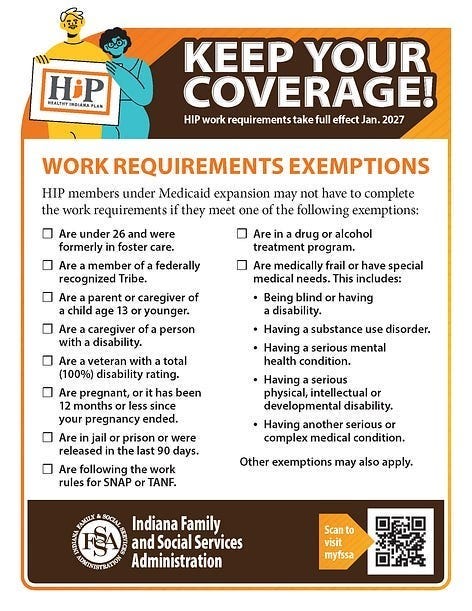
To determine if these changes apply to you, please visit the Family and Social Services Administration’s Benefit Portal. Here, you’ll get more information on the necessary steps you may need to take before these work requirements go into effect.
It is important that you meet these requirements if you are a HIP recipient. If you do not report your hours, your coverage stops, and you must reapply. You also can’t get Marketplace financial help during this time.

Zooming Out: Why This is Happening and What It Means for Hoosiers’ Health
These changes didn’t come out of nowhere. They come from two laws: Indiana’s Senate Enrolled Act 1 (2026), which I voted against, and the federal One Big Beautiful Bill (2025) signed into law last year.
While I support ensuring that no bad actors are taking advantage of our Medicaid system, I believe we have an obligation to make sure that people aren’t getting kicked off their health insurance because they are confused about the changes or their obligations to stay insured. Over the last year, a record number of Hoosier Medicaid recipients have lost their insurance, which could have dire consequences for Hoosiers across the board.
This February, Indiana disenrolled 45.5% of Medicaid enrollees due for renewal for procedural reasons (AKA paperwork issues and missed deadlines, not ineligibility), the highest rate in the nation. This tells you how many people are struggling to keep up with requirements that keep changing.
Troublingly, Indiana currently leads the nation in falling numbers of children insured through Medicaid. Advocates say this is due largely to confusion about eligibility.
Emergency departments in Indiana have seen a surge in uninsured patients over the past year — a 16.8% surge compared to a nationwide surge of just 1.4%.
Here’s why that costs all of us, even if you’re not a Medicaid recipient.
When someone doesn’t have health insurance, they often skip preventative care, only going to the hospital in the event of a medical emergency. Emergency rooms will never turn someone away due to their insurance status, which often leads to the hospital only collecting a fraction of what is owed due to the patient not being able to afford the care needed. This is an already over-burdened system and results in downstream costs for other patients.
Too many Hoosier families are drowning in medical debt, with nearly 1 in 5 Hoosiers having healthcare bills in collections. We have six months before these new requirements take effect, and we need to make sure people have the information they need to prevent them from losing their insurance and having those costs shifted onto other Hoosiers.
If you are currently on Medicaid or know you are likely to enroll in the coming months, I urge you to learn more about the work requirements and documentation you’ll need to successfully enroll. You can find all of that, in English and Spanish, here.
As always, please reach out to my office with any questions, comments or concerns by emailing me here.
In service,

State Rep. John L. Bartlett
Website: in.gov/h95
