
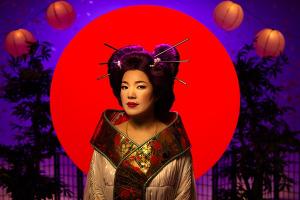
I wanted to love or at least like this new interpretation of Puccini’s heartbreaking opera, “Madama Butterfly.” A beautiful, riveting tragedy of love -- and life – lost, with Puccini’s thrillingly beautiful music infusing depth and drama, audiences have kept this opera a favorite almost since its debut in 1904.
Directed by Matthew Ozawa, whose father is Japanese, his aim was, in his words, to “reclaim the opera’s narrative through the lens of an entirely Japanese and Japanese American creative team,” showing that the central character of Cio Cio San (Butterfly) has been a western fantasy, and that her story all along has been seen through the lens of a white man, Benjamin Franklin Pinkerton, the self-assured early 20th-century American naval officer, bent on experiencing the charms of Japan, where his ship is stationed, but learning very little about its culture and the lovely young woman who falls in love with him, from his purposely limited interactions.
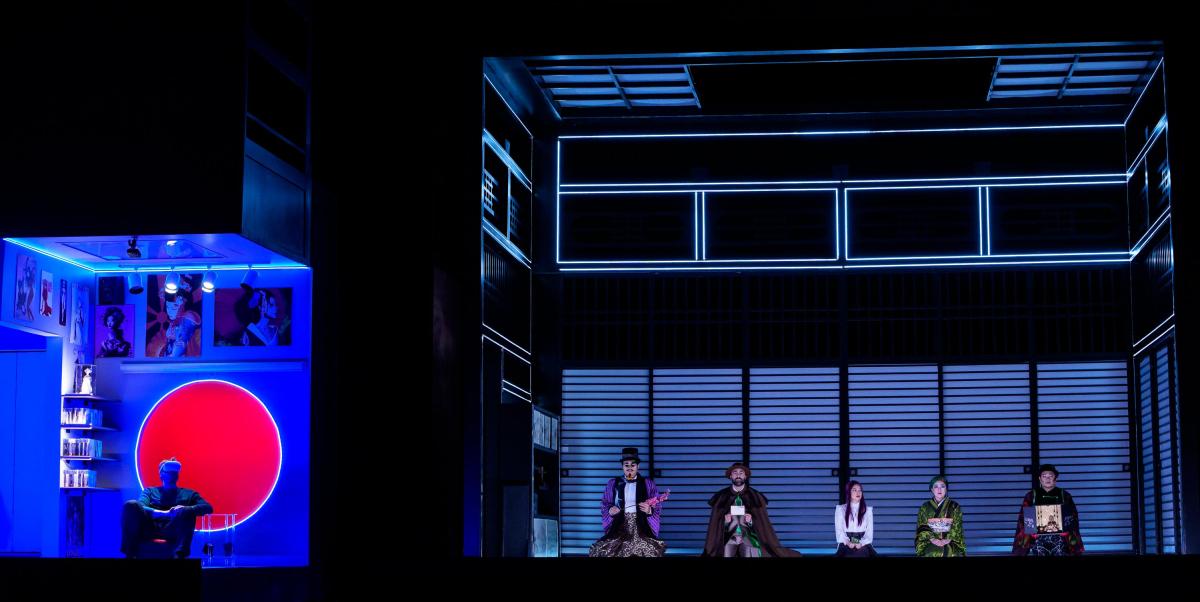
The Company of Madama Butterfly. Photo by Todd Rosenberg
Hence, Ozawa’s modernized production has the tragic story of Butterfly being shown through the construct of a virtual-reality story – complete with a headset that a modern-day fellow named Pinkerton dons to escape his apparently lackluster life and wife, and enter the early 1900s fantasy with a beautiful, idealized geisha – which the modern-day Pinkerton finds himself more and more drawn to.
Virtually, Pinkerton is a handsome naval officer who, while he boasts of the “real American wife” he one day will marry, enthusiastically enters into an arranged marriage with the beautiful geisha, Cio Cio San, who appears to be happy with the arrangement and grows to love the American, never realizing he has no intention of remaining with her, or true to her. She is sensitive and loving, naively romantic and accepting, the classic Puccini heroine who lives, and dies, for love.
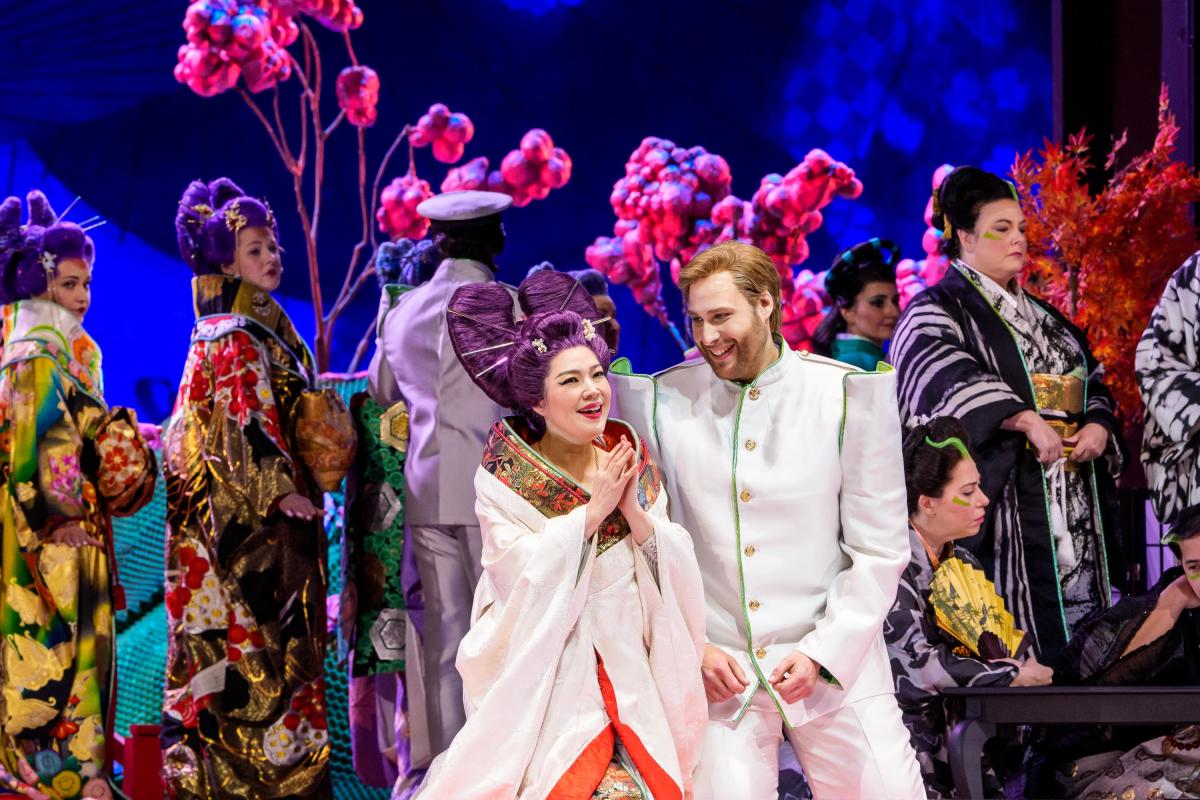
Karah Son as Cio-Cio-San, Evan LeRoy Johnson as Pinkerton, and the Company of Madama Butterfly. Photo by Todd Rosenberg
For his part, of course, Pinkerton’s “marriage” is a temporary romp in this beautiful exotic country for which he has little regard, and he gives equally little thought to his new “wife” as a person in her own right, or a serious future with her. But for this reviewer, placing this tale into a virtual-reality setting did a disservice to the story – and the characters, especially Cio Cio San, the key character the production sought to portray more sensitively.
While I thoroughly appreciated the exquisite creation of a world once-removed from the real world both visually and artistically, for me, removing this captivating tale from actual reality detracted from it, and actually obscured the clarity of the characters.
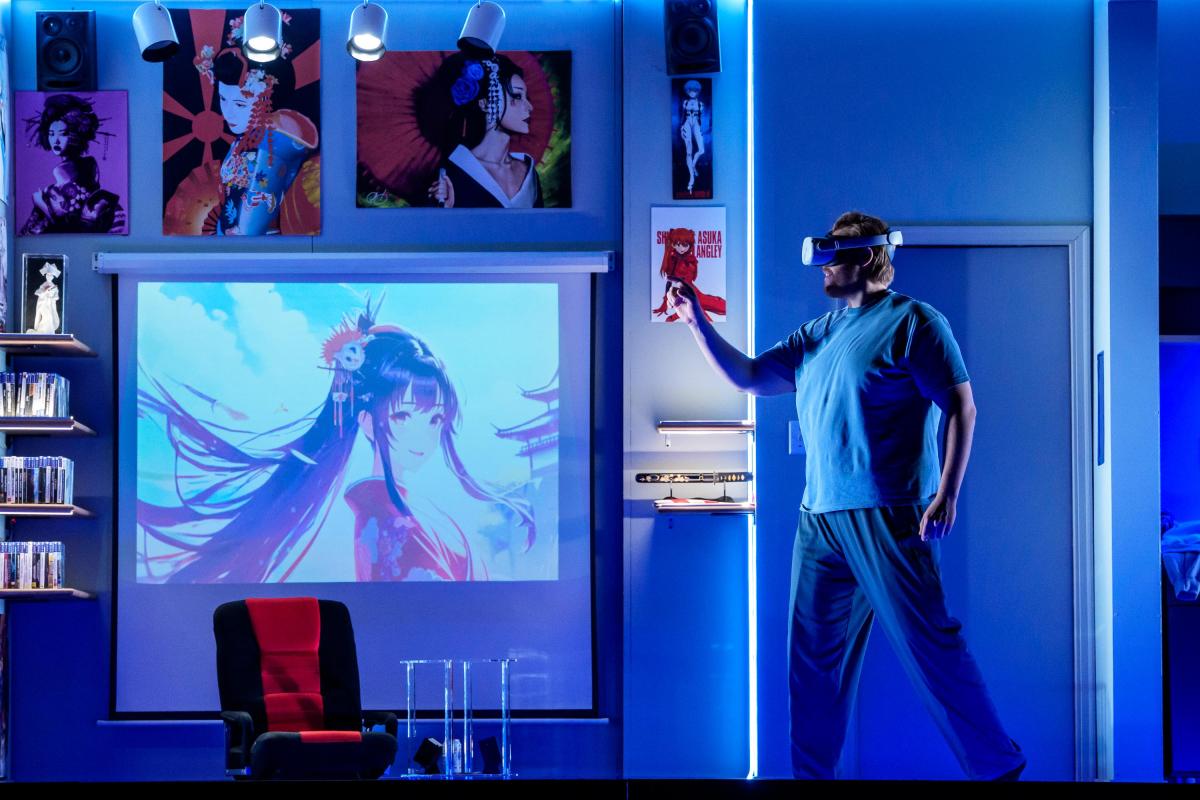
Evan LeRoy Johnson as Pinkerton. Photo by Todd Rosenberg
Ironically, presenting this classic tragedy as a simulated construct rendered the inadvertently villainous Pinkerton less of a cad, infusing him with a humanity his character doesn’t deserve, and reducing the devoted and pure Butterfly’s compelling character to a creation of Pinkerton’s making, which, ultimately, robbed the story of its searing catastrophe.
To be sure, this production is superb on every level -- the set and lighting, the costumes, the pace and direction, the fresh interpretation of the libretto, are all stunning and arresting, visually and otherwise, serving well the theme of a fantasy simulation.
The set by the design collective Dots, based in New York City, fulfilled the director’s mission of placing the story in a fantasy setting, transporting the modern Pinkerton from his modern apartment with its stainless steel kitchen to a lush fantastical Japan, where his virtual dream is warmer than his cold reality. The set’s saturated bold colors reinforce the artificial nature of the virtual world. In one of the first scenes, traditional figures clad in traditional Japanese garb step out of Pinkerton’s refrigerator and into his alternate world of simulated cherry blossoms and a little house with a 999-year lease -- subject to monthly renewal. .
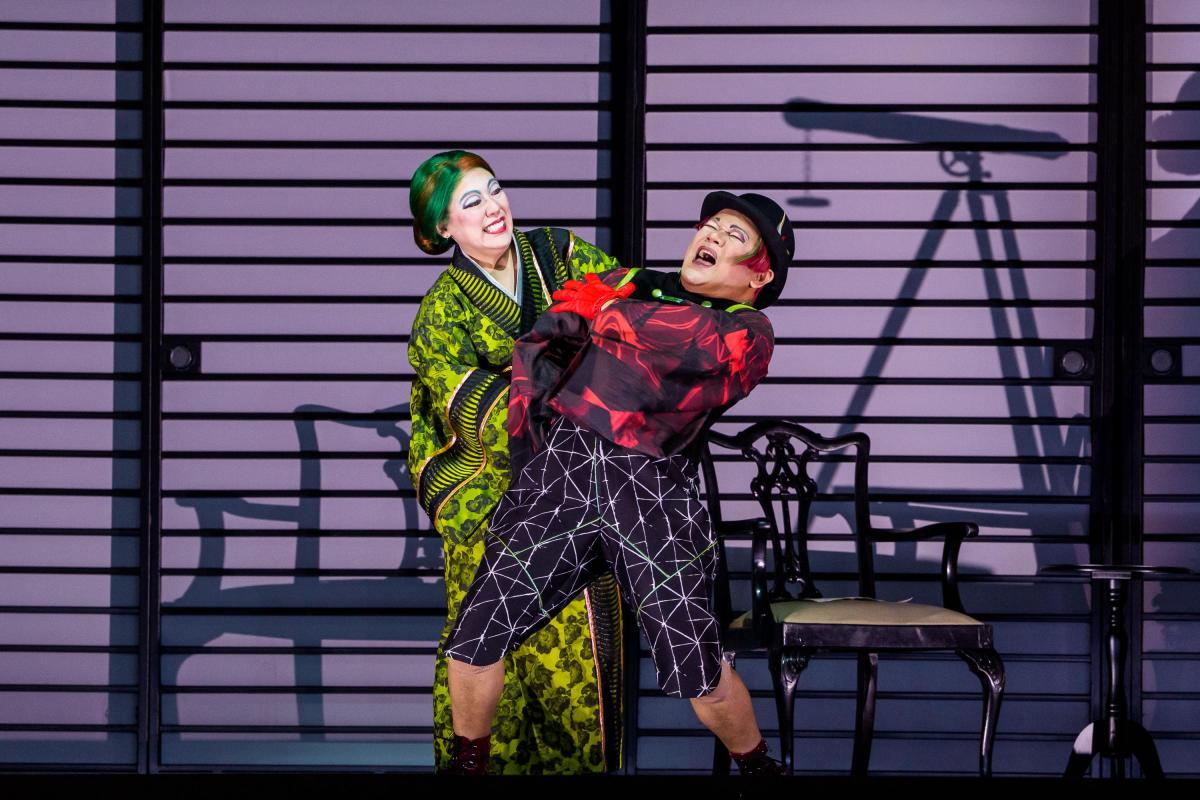
Nozomi Kato as Suzuki and Rodell Rosel as Goro. Photo by Todd Rosenberg
The costumes by Maiko Matsushima in her Lyric Debut, evoke a colorful cartoon of exaggerated patterns, fabric, silhouettes, shoulder pads and obi. Placing Cio Cio San in modern western clothing of the time – a blouse and long skirt – and giving her a modern hairstyle once she marries Pinkerton, signal her deep regard for her husband and his culture, making her eventual betrayal all the more poignant. She even wears a small gold cross, having secretly converted to Christianity before her marriage.
The lighting by Yuki Nakase Link is purposely muted and unnatural, even the scenes that take place outdoors, reminding us we are viewing a graphic image, much as Pinkerton is.
And the cast, led by Korean soprano Karah Son, are wonderful. Son is possibly the best Butterfly ever to appear on the Lyric stage, and Japanese mezzo-soprano Nozomi Kato, possibly the best Suzuki, Butterfly’s devoted servant. Zachary Nelson as Sharpless, brings a fresh humanity to the role, and Evan LeRoy Johnson is convincing as the virtual Pinkerton.
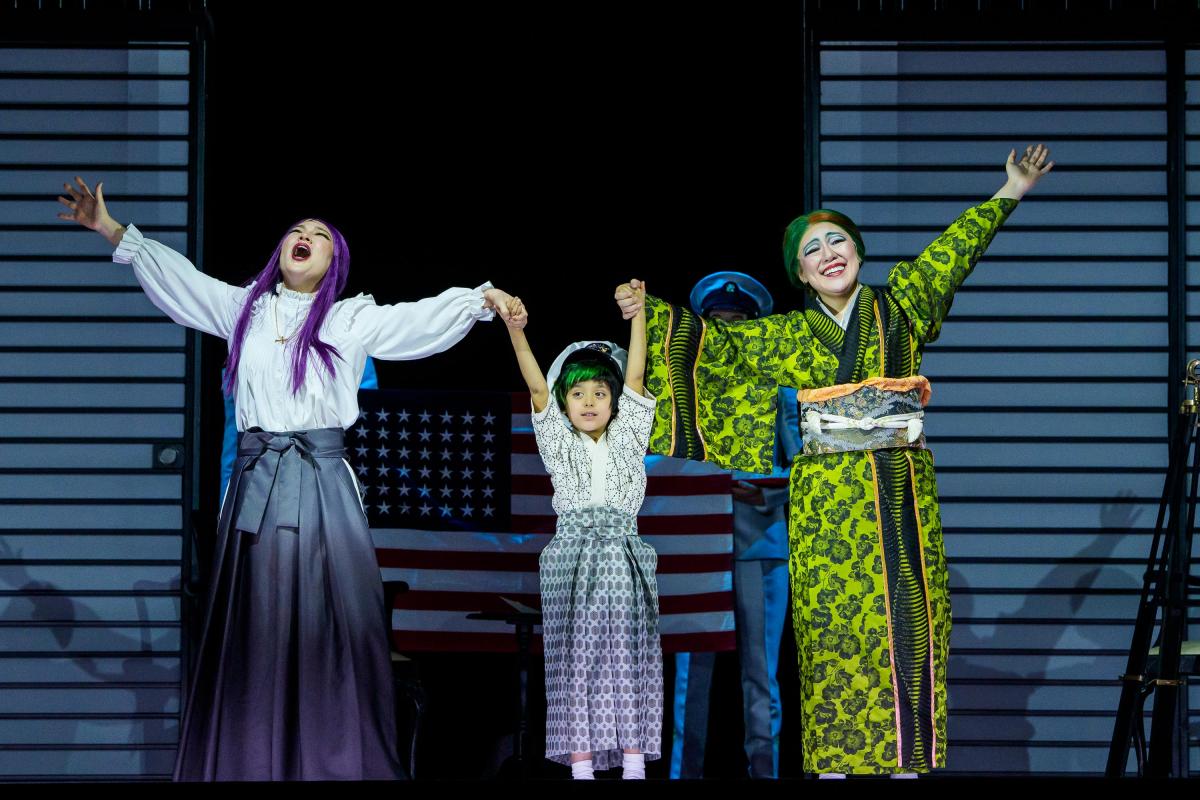
Karah Son as Cio-Cio-San, Florence Agpalo as Trouble, and Nozomi Kato as Suzuki. Photo by Todd Rosenberg
Ironically, Ozawa, to his credit, has infused many of the characters with extra dimensions I hadn’t noticed or appreciated in prior productions. But I was conflicted – the only way to enjoy them in all their complexity was to pretend in my own mind that this was not a virtual-reality headset simulation. I had to ignore Ozawa’s premise and allow myself to become immersed in the story I have always loved – and pretend the modern apartment wasn’t really there. Like the modern-day Pinkerton, I, too, wanted to be immersed in Cio Cio San’s world rather than see it as an artificial environment.
To me, the problem with “Butterfly” as a virtual-headset construct is twofold: first, I didn’t read the program before I saw the production (I never do, purposely), so I frankly had no idea what was going on for a while. I was not clear on what the point was of cramming the lush set and gorgeous, colorful costumes and settings into the little box, literally and figuratively, placed within Pinkerton’s cold-looking kitchen with its cold lighting. Why, I wondered, were we the audience being forced to encounter these colorful characters twice removed -- crammed into a story within the story?
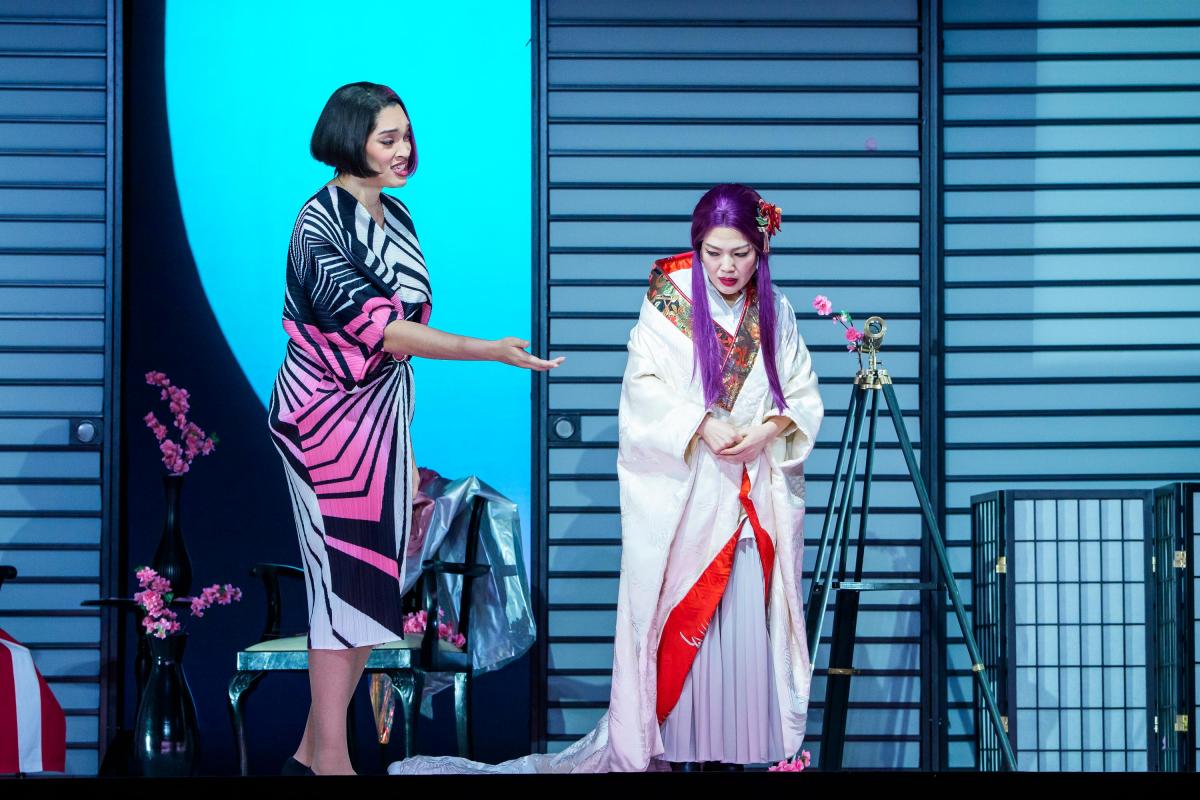
Alexis Peart as Kate Pinkerton and Karah Son as Cio-Cio-San. Photo by Todd Rosenberg
Second, the opera’s focus, for me, now became Pinkerton; it became his story, which I guess is director Ozawa’s point: It was always really Pinkerton’s story. But was I now supposed to feel sorry for this hapless, unhappy modern-day fellow, who seemed as much of a shallow lug as his fantasy naval officer alter-ego?
At least in a more traditional staging, I could dislike his arrogance outright, and see him clearly for the early-20th century chauvinist male and American, he was. This awkward new framework now emphasized Pinkerton, and his preferences and reactions, and I do not think this is ever what Puccini intended when he created the tragic and beloved character of Cio Cio San.
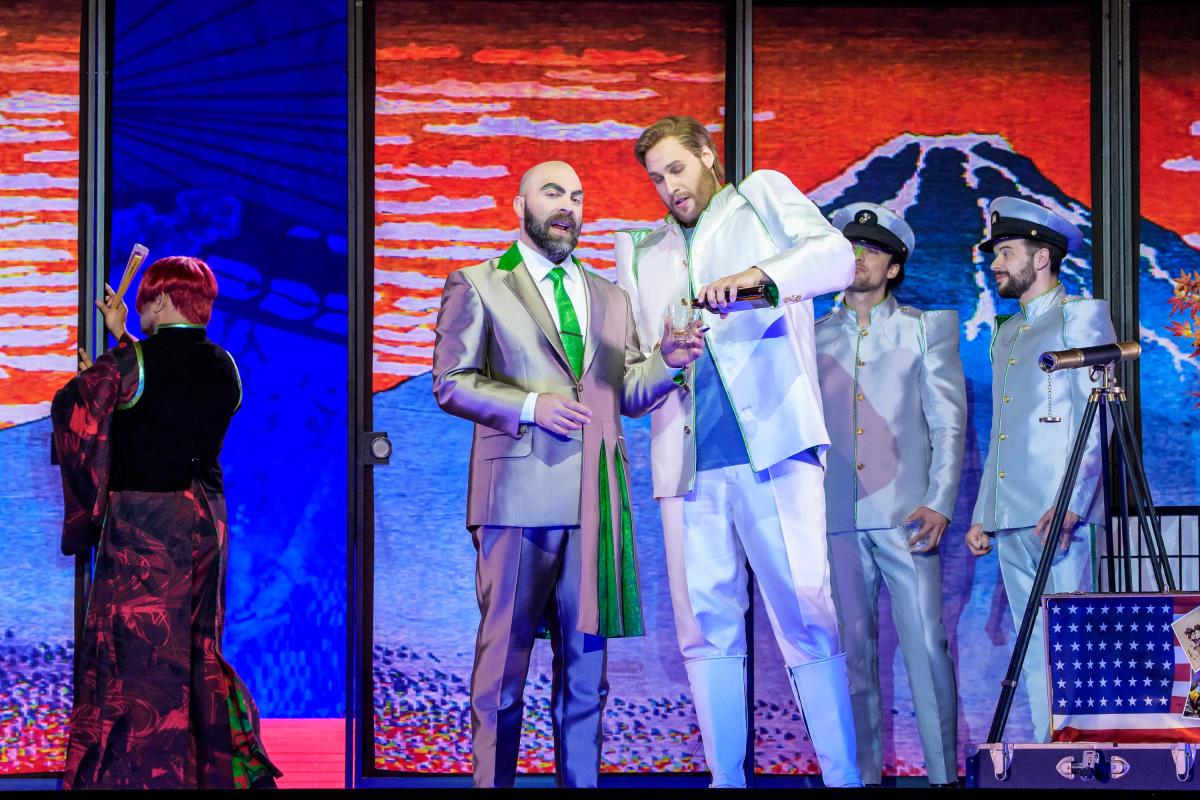
Rodell Rosel as Goro, Zachary Nelson as Sharpless, and Evan LeRoy Johnson as Pinkerton. Photo by Todd Rosenberg
Once I read the program after the show, I found the story still had nowhere else to go in my own mind once Pinkerton donned the headset. Was I now supposed to see the beautiful, tragic story as a cartoon? Was Butterfly’s charm and trusting innocence now to be seen as a cultural manipulation?
I don’t think audiences have ever been misled by any unintentional cultural misappropriation on Puccini’s part. Audiences have always viewed this opera as Butterfly’s story, her character a universal and noble one.
And I always interpreted Butterfly’s so-called lack of agency, her sacrifice, as a metaphor for the sacrifices of all women – and mothers – across cultures throughout history. Her struggles are every woman’s struggle to survive and thrive; her heartbreak is every woman’s heartbreak, to one degree or another. That is what has always given this melancholic, desperate tale its timeless and profound cathartic power.
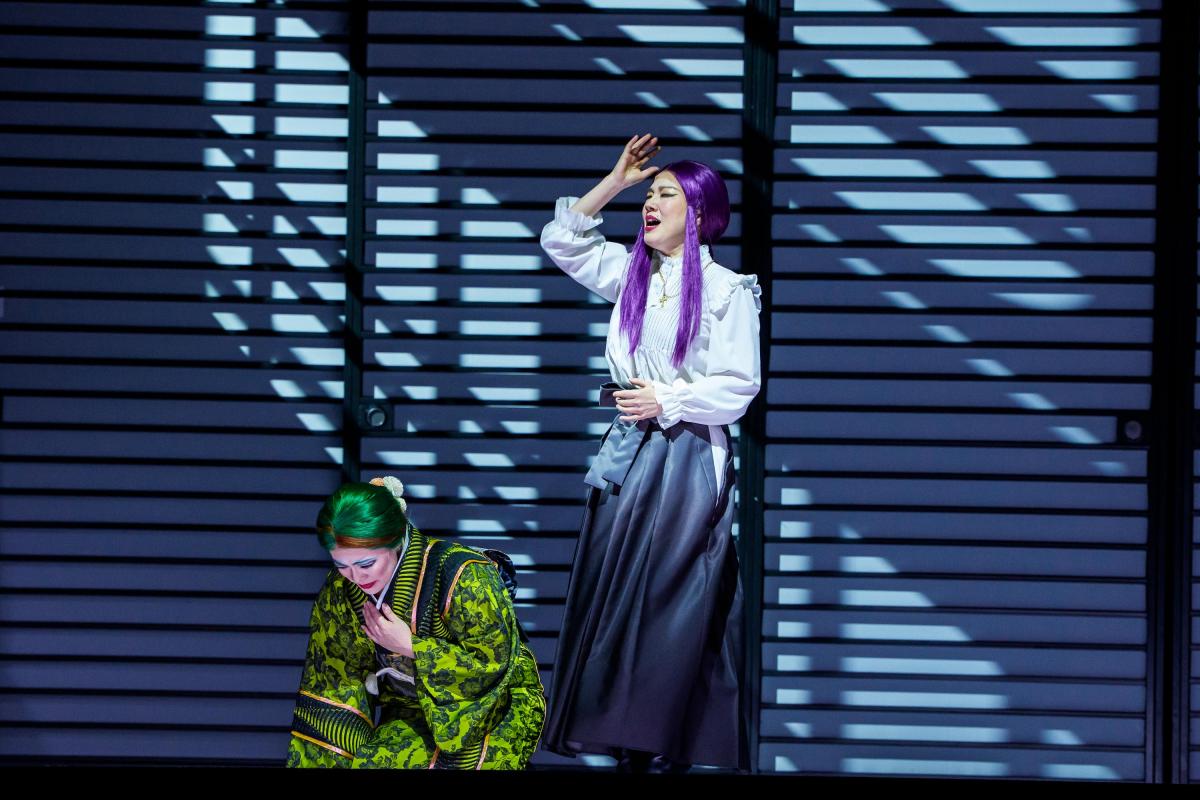
Nozomi Kato as Suzuki and Karah Son as Cio-Cio-San. Photo by Todd Rosenberg
When the inevitable end comes for Butterfly, Son’s exquisite and powerful voice, and her no-holds barred interpretation lift her fate and her story from the virtual into the realm of the real, transporting the audience to that magical place where art and life merge.
Whatever unintended cultural insensitivity Puccini may have baked into this opera, it’s hard to deny that the story’s drama still resonates with modern audiences and reflects his deep regard for humanity, and women, and a love of characters with varying degrees of complexity.
In the end, the virtual concept did not resonate with me, and did this moving, gorgeous opera a disservice. Nonetheless, because of Ozawa’s masterful, innovative and wise reframing overall, the production is compelling and absolutely worth seeing.
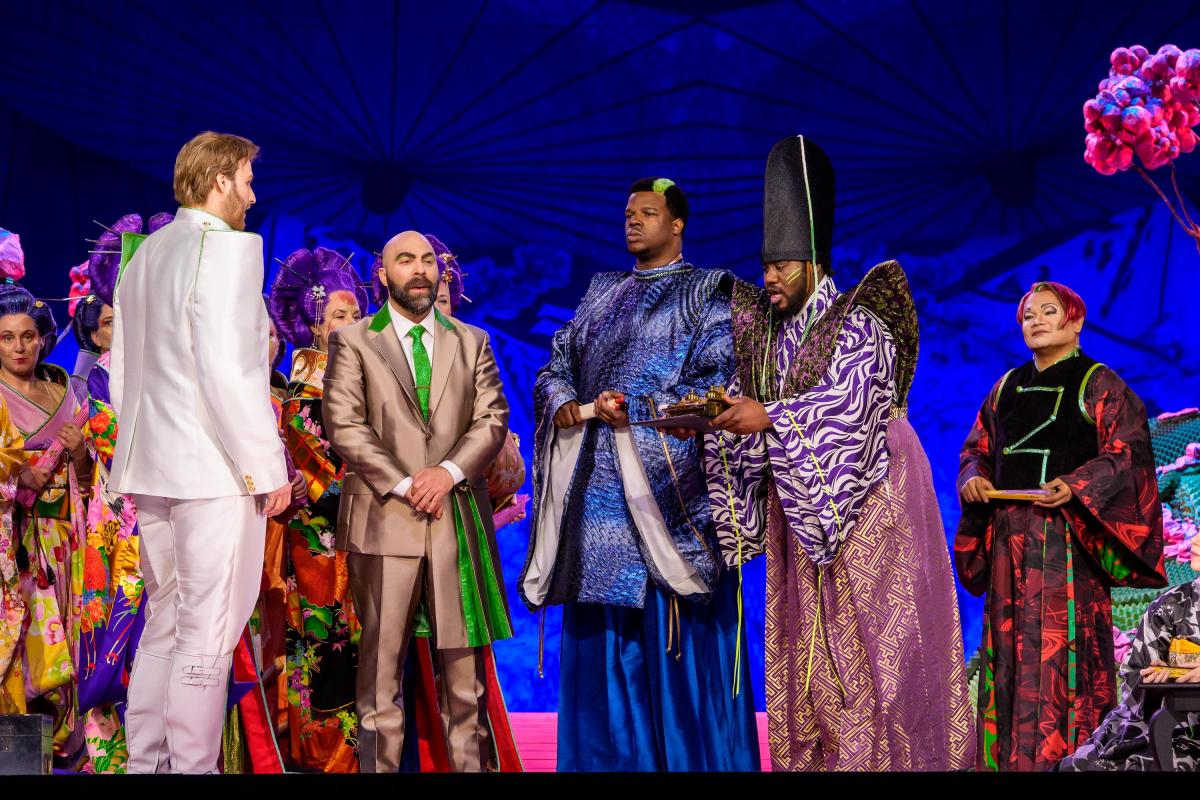
The Company of Madama Butterfly. Photo by Todd Rosenberg
“Madama Butterfly” runs through April 12th at Lyric Opera, Lyric Opera House, 20 N. Wacker Drive, Chicago.
For information and tickets visit lyricopera.org.