
Fall Hunting Prep Made Easy
The fall hunting season is finally here! Let Indiana DNR simplify your hunting preparations into a few easy steps to ensure you’re ready for a successful season.

Step 1: Download the GoOutdoorsIN app (iOS / Android) to keep licenses on your phone and check in harvests on the go.
Step 2: Buy your licenses and stamps early. Explore our activity packages and deer bundle to add licenses and stamps to your cart in one simple transaction.
Not sure which license you need? Use our Sport License Finder for quick guidance.
Step 3: Pick up one of this year's license hard cards and carry it with pride.
Visit the Learn to Hunt page for maps, tips, workshops, and more, or check out our new Resource Hunting Pack on page 19 of the 2026-2027 Hunting & Trapping Guide.
View the Hunting & Trapping Guide
Celebrate National Hunting & Fishing Day Outdoors

Celebrate National Hunting and Fishing Day on Saturday, Sept. 26, by enjoying Indiana’s great outdoors! The day marks the opening of youth deer season and Indiana’s last Free Fishing Day of the year, making it a great time to introduce a new hunter or angler to their respective sports.
Every license purchased helps fund wildlife conservation, habitat restoration, public access, and outdoor recreation in Indiana. By hunting and fishing, you’re not only making memories — you’re helping conserve our natural resources for future generations.
Visit our hunting and fishing webpages for more information or check out our calendar of events for workshops near you!
Avoid This Mistake When Checking in Youth Game

We have noticed that parents are frequently checking in deer on their own accounts rather than their child’s account. If your child has harvested a deer that requires check-in, be aware that there are different steps depending on the child’s age.
If you’re checking in game for a youth under age 13 who is linked to your account, you have a few options available.
- Call 260-368-5880 (no charge) with the child's Customer ID number and date of birth.
- Click on the CheckIN Game button on GoOutdoorsIN.com (no login required). You will need the child's Customer ID number (OR last 4 digits of their SSN), last name, and date of birth.
- If you would like to log in to your GoOutdoorsIN.com account, be sure to switch to the youth’s account first under Youth Association before continuing the check-in process. To do this, click on “Customer Group/Youth Association,” select the “Youth Association” tab, and click on the child’s Customer ID number. A new screen will open where you can check in your child’s harvest.
If you don’t see your child’s name listed, you will need to connect their account to yours. You can find instructions here.
If you do not see “Manage Account” next to your child’s name, you can either email inhuntfish@dnr.IN.gov for assistance or unlink and then re-link your child to your account. Make sure to select “Account Manager” when re-linking.
To check in game for someone age 13 or older who is linked to your account, you have two options available.
- Call 260-368-5880 (no charge) with the person’s Customer ID number and date of birth.
- Click on the CheckIN Game button on the GoOutdoorsIN.com homepage (no login required). You will need the person’s Customer ID number (OR last 4 digits of their SSN), last name, and date of birth.
Tracking EHD in Indiana’s Deer Population

Epizootic hemorrhagic disease (EHD) is a potentially fatal virus in white-tailed deer that is transmitted by biting midges that live in small pools of standing water and mud. EHD occurs naturally in the deer population and affects them every year. Clinical signs of the disease may include not eating, weakness, loss of fear of humans, inability to stand, excessive drooling, or other unusual behaviors. Typically, deer that die from EHD are found by water. EHD is often fatal, but some deer will survive and develop immunity.
Help DNR track EHD by reporting dead deer found in or near water in the late summer months through the online sick/dead wildlife reporting tool. When possible, these deer are tested to confirm the presence of EHD. Maps of EHD reports by county are available showing the number of suspected, confirmed, and tested deer during outbreaks.
2026-2027 Migratory Bird Hunting Seasons

Several migratory bird hunting seasons open in September and October. Full migratory bird hunting season dates, as well as bag limits, are available online.
View Migratory Bird Hunting Seasons
Recognize National Public Lands Day with DNR

National Public Lands Day is Saturday, Sept. 26, and DNR invites everyone to spend the day caring for our shared natural resources.
Outdoor enthusiasts who are looking to get active on public lands can check out the DNR Calendar for programs and volunteer events happening across the state around Sept. 26. Want to support conservation from home? DNR has fun, informational videos to help you learn more about public lands conservation. You can also support conservation by purchasing a hunting, fishing, or combo license. Buying a license supports public land conservation and helps Indiana DNR protect our natural resources for future generations.
Learn More About Indiana Public Lands
Share the Outdoors with Someone New

Fall is the perfect time to create lasting memories outdoors. By introducing a young hunter, veteran, friend, or family member to hunting and fishing, you can inspire someone’s first outdoor adventure and spur lifelong mental, physical, and environmental health benefits.
Youth deer season returns Sept. 26-27, offering hunters 17 and younger a chance to spend time in the field with a mentor. Youth and veteran waterfowl seasons also provide special opportunities beginning in October for new and experienced hunters.
Know someone who has always wanted to try hunting but hasn’t completed hunter education? An apprentice hunting license allows them to get started alongside an experienced mentor. DNR also offers adult hunting and fishing workshops for beginners or those looking to sharpen their skills.
This fall don’t just enjoy the outdoors yourself — invite someone else to experience it for the first time!
Native Blooming Trees, Shrubs, and Wildflowers

Now is the time to be thinking about planting native trees, shrubs, wildflowers, and prairies for next year.
Native plants, which originated naturally in a region, provide more benefits to local insects and wildlife than non-native plants do. DNR’s district wildlife biologists can provide technical assistance for your native plantings and state nurseries are great sources for seedlings to plant in the spring of 2027.
In addition to benefitting insects and wildlife, native blooming trees, shrubs, and wildflowers beautify your landscaping and are great for filling large, open spaces on your property. Redbud, flowering dogwood, serviceberry, gray dogwood, and silky dogwood are small trees and shrubs that provide brilliant blooms in the spring. Native prairie species that include a diverse mix of wildflowers can provide blooms from spring through fall. Whatever your needs, native plantings are a great choice.
Salmon and Steelhead Fishing Tips for Lake Michigan and Its Tributaries

Starting in late August, a few early Chinook and coho salmon can be found temporarily resting and feeding around the entrance to tributary streams of Lake Michigan. Most salmon return to streams for spawning in mid-September through late October. Salmon like cooler water, so fish for them when Lake Michigan surface temperatures are under 70 degrees and stream temperatures are under 60 degrees. Rain also helps spur salmon spawning migration.
For shore fishing in Lake Michigan itself, the mouth of Burns Ditch at City of Portage Lakefront Park, Michigan City Harbor, and East Chicago Marina all receive salmon stockings that support fall returns of mature fish. Trail Creek, Salt Creek, East Branch Little Calumet River, and Deep River are the places to try if you want to stream fish in Lake, LaPorte, or Porter counties. A variety of DNR public fishing areas and city and county parks provide fishing access. Many of these can be found using our interactive Where to Fish map. You can also check out DNR’s Fishing Reports or call our Lake Michigan Office for more information at 219-874-6824.
Don’t forget that anglers will need both a fishing license and a trout/salmon stamp, which can be bought online. Be sure to review current fishing regulations. As of 2026, bag limits are five trout and salmon combined, of which no more than three can be lake trout.
How Old Is That Fish?
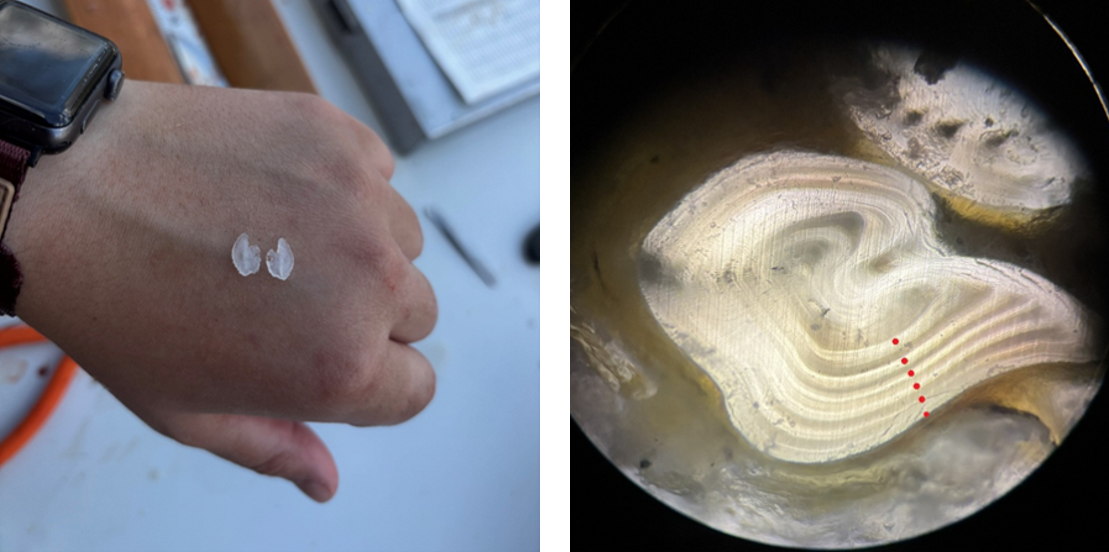
Left: Black crappie otoliths on the back of a hand.
Right: Cross section of a pectoral ray showing 6 annuli rings marked by red dots.
Do you ever wonder what DNR fisheries biologists do during the cooler seasons? On a typical day, you’re likely to find them examining aging structures. These structures aren’t old buildings, though! They’re the various parts of the fish that give clues to its age.
During surveys, fisheries biologists collect structures, or “hard parts,” like scales, spines, and otoliths (parts of a fish’s inner ear). As fish grow and age each year, these structures gain a ring known as an annulus. Like tree rings, annuli can be counted to determine how old the individual is. Some structures, like otoliths, can even be used to see how many days old a fish is when they are in their larval stage.
By examining these structures, biologists can better understand the health and growth of Indiana’s fish populations. This data provides more information about how many fish survive to adulthood, overall survival rates, and population stability. By understanding when fish populations are missing certain age groups, biologists can make informed decisions about harvest regulations, stocking needs, and habitat improvements. To learn more, contact your district fisheries biologist.
NRC Meets to Vote on Proposed Wildlife-related Rule Changes
The Natural Resources Commission (NRC) will vote on final adoption of proposed wildlife-related rule changes at their meeting on Sept. 15. The meeting will start at 10 a.m. (ET) at the Garrison (Fort Event Center) at Fort Harrison State Park, located at 6002 N. Post Road, Indianapolis. The agenda, including the proposed rule language, public comments, and response from DNR, are expected to be posted by Sept. 8 at IN.gov/nrc/meetings-and-minutes/.
Rule changes that are given final adoption by the NRC will still need to be approved by the Attorney General’s Office and Governor’s Office before taking effect. For more information about the rule proposals, go to on.IN.gov/dfw-rule-changes/.
Follow Us on Social Media:


Upcoming Events
9/15 | Basic Deer Processing Workshop, West Lafayette
9/18 | Forests & Watersheds with Project WET and Project Learning Tree, Knox
9/19 | Introduction to Deer Hunting Workshop, Pigeon River FWA
9/22 | Women's Catfish Fishing Workshop, Robinson Lake Park
9/23 | Plant Native Workdays, Indiana State Fairgrounds DNR Building
9/26 | Introduction to Squirrel Hunting Workshop, Atterbury FWA
9/26 | Brushing of the Blinds, Kankakee FWA
10/3 | Introduction to Deer Hunting Workshop in Partnership with the Indiana Chapter of BHA, Atterbury FWA
10/6 | Not-So-Spooking Wildlife Educator Workshop, Porter

Recent News Releases
- Gov. Braun & Indiana DNR Announce Expansion to Martin State Forest
- Natural Resources Commission Seeks Input on Proposed Wildlife Rule Change
- Reserved Hunt Applications Open for Waterfowl, Deer, and Gamebirds
- Put-and-take Pheasant Hunt Reservations Open Sept. 9
- Indiana DNR reminds Hoosiers of Upcoming Free Hunting and Fishing Opportunities in September
More
- Buy a License
- Hunting Information
- Where to Hunt
- Fishing Information
- Where to Fish
- Fish & Wildlife Properties
- Donate to Help Rare and Endangered Species